Fantasy Has Always Been About Challenging the Impossible
Fantasy is one of the most powerful forms of storytelling. It allows readers to travel through magical worlds, encounter extraordinary creatures, and imagine realities beyond the limits of everyday life. Yet despite its limitless imagination, fantasy has often been limited in one important way: who gets to be the hero.
For decades, many fantasy stories around the world have focused on characters who already possess power, privilege, royal bloodlines, or special destinies. While these stories can be entertaining and inspiring, they often leave out the experiences of millions of people whose lives are shaped by social barriers, discrimination, and unequal opportunities.
In India, this question becomes even more significant because our society has long been influenced by systems of hierarchy, class, caste, and inherited privilege. As a result, many readers are beginning to ask an important question:
What happens when the hero comes from a community that has historically been pushed to the margins?
The answer is simple: fantasy becomes more meaningful, more relatable, and ultimately more powerful.
The Growing Demand for Diverse Voices in Indian Fiction
Across the world, readers are increasingly searching for stories that reflect a wider range of experiences.
People want heroes who feel real.
They want characters who struggle with obstacles that resemble the challenges found in everyday life. They want stories that explore identity, dignity, belonging, and resilience.
Indian literature has already seen important contributions from Dalit writers, Bahujan thinkers, and authors who challenge traditional narratives. However, these voices have often been concentrated in memoirs, social commentary, and realistic fiction.
Fantasy remains a largely untapped space.
Imagine a world where magical adventures, futuristic technology, mythology, and epic battles exist alongside conversations about equality, representation, and social justice.
Such stories do not weaken fantasy. They strengthen it.
They allow readers to explore difficult questions through imagination while still enjoying adventure, mystery, and wonder.
Why Representation Matters in Fantasy
Representation is often misunderstood.
Some people assume it simply means placing different types of characters into a story. In reality, representation is about much more than visibility.
It is about possibility.
When readers encounter heroes who share aspects of their background, culture, language, or struggles, they see new possibilities for themselves.
A young reader from a marginalized community may not see themselves in a king, prince, or chosen warrior. But they may deeply connect with a character who faces exclusion, prejudice, or limited opportunities and still chooses to fight for a better future.
That connection can be transformative.
Fantasy allows readers to imagine worlds beyond reality. Representation allows them to imagine a different future for themselves.
The Indian Context: Stories Beyond Privilege
India contains extraordinary diversity.
It is home to countless languages, traditions, communities, and cultural histories. Yet many mainstream stories continue to focus on a relatively narrow range of experiences.
As conversations around equality, constitutional values, and social justice become increasingly important, readers are searching for stories that reflect modern India in all its complexity.
This does not mean every fantasy novel must become political.
It means recognizing that stories become richer when they include perspectives that have historically been overlooked.
Fantasy can explore themes such as:
- Identity and belonging
- Social mobility
- Inherited privilege
- Resistance against unfair systems
- Community and solidarity
- The search for dignity and respect
These themes resonate deeply because they are both universal and uniquely relevant to Indian society.
Mythology, Imagination, and Social Change
India possesses one of the richest mythological traditions in the world.
The Mahabharata, Ramayana, Puranas, Buddhist narratives, and countless regional legends contain stories of heroes from diverse backgrounds. Many of these stories question authority, challenge injustice, and celebrate courage in unexpected forms.
Modern fantasy has an opportunity to build upon this tradition.
By combining mythology with speculative fiction, authors can create entirely new worlds while exploring timeless questions:
- Who gets to hold power?
- What makes a hero?
- Can ordinary people challenge destiny?
- Is social status more important than character?
Fantasy provides a safe space to explore these ideas without preaching.
Instead of telling readers what to think, it invites them to imagine.
The Rise of Social Justice Fantasy
A growing number of readers are interested in stories that combine adventure with meaningful themes.
This has led to the rise of what some readers call social justice fantasy.
These stories retain everything people love about fantasy:
- Magic
- Adventure
- Epic conflicts
- Strange worlds
- Memorable characters
At the same time, they also explore questions about fairness, inequality, and human dignity.
Importantly, social justice fantasy is not about replacing entertainment with lectures.
The best stories entertain first.
They capture the imagination through exciting characters and compelling plots. The deeper themes emerge naturally through the journey.
Why Underdog Heroes Inspire Us
One reason readers love fantasy is because they enjoy seeing unlikely heroes succeed.
The underdog is one of the most enduring figures in storytelling.
Whether it is a farmer becoming a warrior, an orphan discovering hidden strength, or an ordinary student saving the world, underdog stories resonate because they remind us that greatness can emerge from unexpected places.
Marginalized heroes represent the ultimate underdogs.
They often begin with fewer advantages.
They face greater obstacles.
Their victories feel more meaningful because they must overcome barriers that others never encounter.
When such characters rise, readers celebrate not only their success but also their resilience.
Fantasy as a Mirror of Society
Fantasy is sometimes dismissed as escapism.
In reality, many of the greatest fantasy stories serve as mirrors that reflect aspects of the real world.
Through imaginary kingdoms, distant planets, magical systems, and cosmic adventures, authors explore real questions about human behavior.
The most memorable fantasy stories ask readers to think about:
- Justice
- Power
- Freedom
- Responsibility
- Equality
These themes remain relevant regardless of the setting.
A story set in another galaxy can still reveal important truths about life on Earth.
Why Indian Readers Are Ready for Change
Today’s readers are different from previous generations.
They are exposed to global literature, anime, streaming platforms, graphic novels, mythology retellings, and social media conversations.
As a result, they expect stories to be both entertaining and meaningful.
Many readers want:
- Strong female protagonists
- Diverse perspectives
- Complex social themes
- Unique world-building
- Fresh approaches to mythology
The demand for these stories is only growing.
Authors who embrace this shift have an opportunity to create entirely new forms of Indian fantasy.
The Future of Indian Fantasy Literature
Indian fantasy is entering an exciting period.
Writers are increasingly blending mythology, science fiction, social commentary, folklore, and speculative fiction into stories that feel distinctly Indian while appealing to global audiences.
The future of the genre will likely include:
- More diverse heroes
- More regional influences
- Greater representation
- Innovative world-building
- New interpretations of mythology
This evolution benefits everyone.
Readers gain access to richer stories.
Writers gain opportunities to explore new ideas.
And the genre itself becomes more vibrant and inclusive.
Conclusion
Fantasy has always been about imagining worlds that do not yet exist.
Perhaps the next step is imagining worlds where heroism is not limited by birth, status, privilege, or social expectations.
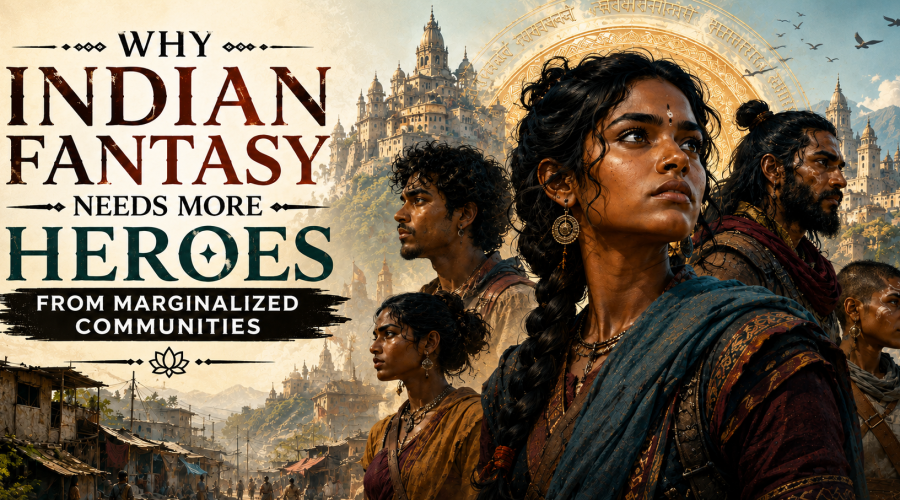
By creating heroes from marginalized communities, Indian fantasy can become more representative, more meaningful, and more inspiring.
Such stories remind us that courage can emerge from unexpected places.
That dignity belongs to everyone.
And that sometimes the people dismissed as outsiders are the very ones capable of changing the world.
The future of Indian fantasy does not belong only to kings, warriors, and chosen ones.
It belongs to everyone brave enough to imagine something better.