Introduction
Stories shape how we see ourselves and the world around us. They influence our understanding of justice, identity, power, and possibility. For generations, Indian literature has given voice to diverse experiences, cultures, and traditions. Yet many communities have historically struggled to see their own realities reflected in mainstream storytelling.
Over the last century, Dalit literature, Bahujan literature, and Ambedkarite writing have played a transformative role in changing this landscape. These movements created space for voices that had long been excluded from dominant narratives and challenged readers to confront uncomfortable truths about inequality and social hierarchy.
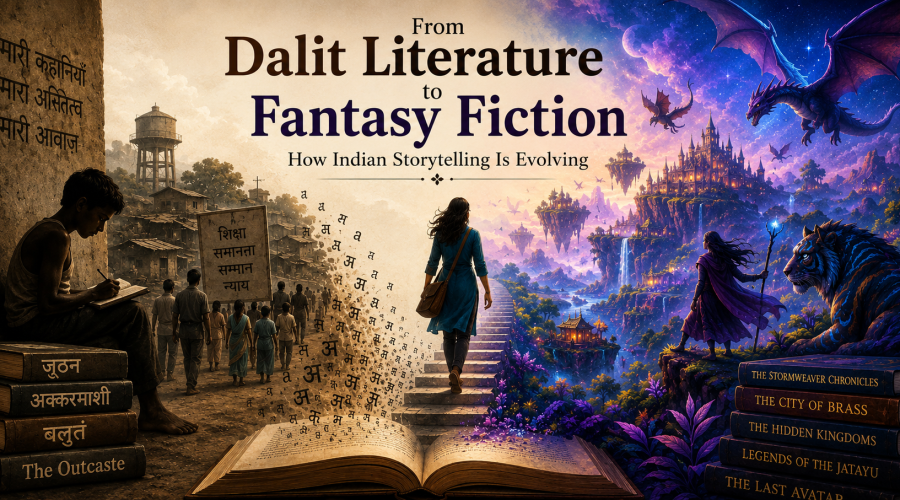
Today, a new generation of writers is taking these themes beyond realism and autobiography into genres such as fantasy, science fiction, and speculative fiction. As Indian storytelling evolves, readers are discovering that conversations about dignity, equality, and social justice can exist alongside magical worlds, futuristic technology, and epic adventures.
The result is a new era of Indian fiction—one where imagination and social reflection go hand in hand.
What Is Dalit Literature?
Dalit literature emerged as a powerful literary movement dedicated to expressing the experiences, struggles, and aspirations of communities historically affected by caste discrimination.
Unlike traditional narratives that often spoke about marginalized communities from an outsider’s perspective, Dalit literature allowed people to tell their own stories in their own voices.
Its purpose has never been limited to documenting suffering. At its best, Dalit literature explores resilience, self-respect, identity, resistance, and hope.
These stories challenge readers to question systems that appear normal and encourage society to imagine more equitable alternatives.
Over time, Dalit literature has become one of the most influential forces in modern Indian writing, inspiring authors, scholars, activists, and readers across generations.
Dr. B. R. Ambedkar and the Power of Storytelling
Any discussion of social equality in India eventually leads to the ideas of Dr. B. R. Ambedkar.
Although he is primarily remembered as the principal architect of the Indian Constitution, Ambedkar also understood the importance of ideas, education, and cultural narratives in shaping society.
His famous principles—
Educate. Agitate. Organize.
continue to inspire movements focused on empowerment and social transformation.
Ambedkar believed that dignity and equality could not be achieved solely through laws. People also needed access to knowledge, opportunities, and the ability to tell their own stories.
Modern literature continues this mission by creating spaces where readers can explore questions of identity, representation, and justice.
Many contemporary authors, whether writing realistic fiction or fantasy, draw inspiration from values often associated with Ambedkar’s vision:
- Liberty
- Equality
- Fraternity
- Human dignity
- Social justice
These principles remain relevant in storytelling today.
Why Representation Matters in Fiction
Representation is not simply about including different kinds of characters.
It is about expanding the range of experiences that readers can encounter.
When literature consistently focuses on a narrow group of heroes, it unintentionally sends a message about who deserves attention and whose stories matter.
By contrast, diverse representation allows more readers to recognize themselves within a story.
This is particularly important for young readers.
A teenager who rarely sees characters sharing their background, challenges, or aspirations may begin to believe that heroic journeys belong to someone else.
Stories can challenge that assumption.
When readers encounter heroes who overcome barriers, question unfair systems, and refuse to accept limitations imposed upon them, they discover new possibilities for themselves.
From Social Realism to Speculative Fiction
Historically, many works dealing with caste discrimination and social inequality have been rooted in realism.
These stories remain essential because they document real experiences and expose ongoing challenges.
However, a growing number of writers are exploring these themes through speculative fiction.
Speculative fiction includes:
- Fantasy
- Science fiction
- Alternate histories
- Dystopian fiction
- Futuristic worlds
These genres provide unique opportunities to examine social structures from fresh perspectives.
A distant planet can mirror social divisions on Earth.
A futuristic society can reveal the consequences of inequality.
A fantasy kingdom can expose assumptions about power and privilege.
By creating new worlds, writers gain the freedom to ask difficult questions in imaginative ways.
The Rise of Social Justice Fantasy
Fantasy has traditionally focused on kings, warriors, chosen heroes, and ancient prophecies.
While these elements remain popular, modern readers increasingly seek stories that explore broader perspectives.
This has contributed to the rise of social justice fantasy.
Such stories combine adventure, mystery, world-building, and imagination with themes such as:
- Equality
- Identity
- Community
- Resistance
- Representation
- Human dignity
Importantly, social justice fantasy succeeds when it remains a compelling story first.
Readers want excitement, memorable characters, and emotional journeys.
The deeper themes work best when they emerge naturally through the narrative rather than feeling like lectures.
The strongest fantasy stories entertain while also encouraging reflection.
Indian Mythology, Science Fiction, and New Voices
Indian storytelling has always embraced imagination.
Ancient epics, regional folklore, Buddhist narratives, and mythological traditions are filled with extraordinary journeys, cosmic battles, and profound philosophical questions.
Today, many authors are combining these influences with modern science fiction and fantasy.
This fusion creates exciting possibilities:
- Ancient wisdom meets futuristic technology.
- Mythological symbolism meets space exploration.
- Social commentary meets adventure.
- Spiritual questions meet speculative fiction.
Readers increasingly enjoy stories that feel distinctly Indian while still appealing to a global audience.
This blend of mythology and science fiction is becoming one of the most exciting developments in contemporary Indian literature.
Why Underdog Heroes Continue to Inspire Readers
Across cultures, readers are drawn to underdog stories.
We admire characters who begin with disadvantages but refuse to surrender.
Underdog heroes remind us that courage does not depend on privilege.
They show that determination, integrity, and resilience can emerge from unexpected places.
For many readers, these stories feel more relatable than tales centered entirely on inherited power.
The underdog’s journey reflects challenges that ordinary people experience in their own lives.
This emotional connection explains why such characters remain among the most beloved figures in literature.
The Future of Indian Fantasy Fiction
Indian fantasy is undergoing a period of transformation.
New voices are entering the genre.
New themes are being explored.
New readers are demanding stories that feel both entertaining and meaningful.
The future of Indian fantasy is likely to include:
- Greater diversity of characters
- Richer cultural influences
- More speculative fiction rooted in Indian experiences
- Stronger female protagonists
- Innovative world-building
- Deeper exploration of social themes
This evolution is creating opportunities for stories that are imaginative, inclusive, and uniquely Indian.
Conclusion
The journey from Dalit literature to fantasy fiction reflects a broader evolution in Indian storytelling.
Writers are increasingly demonstrating that themes of equality, dignity, representation, and social justice are not limited to realistic narratives. They can thrive in fantasy worlds, futuristic galaxies, and speculative adventures as well.
As readers continue to seek stories that combine imagination with meaning, the boundaries between social commentary and genre fiction will continue to fade.
The future belongs to stories that dare to ask difficult questions, imagine better possibilities, and give voice to experiences that deserve to be heard.
And in that future, heroes can come from anywhere.